Resource Management Approach to An Efficient Wireless Sensor Network
Read more … Resource Management Approach to An Efficient Wireless Sensor Network


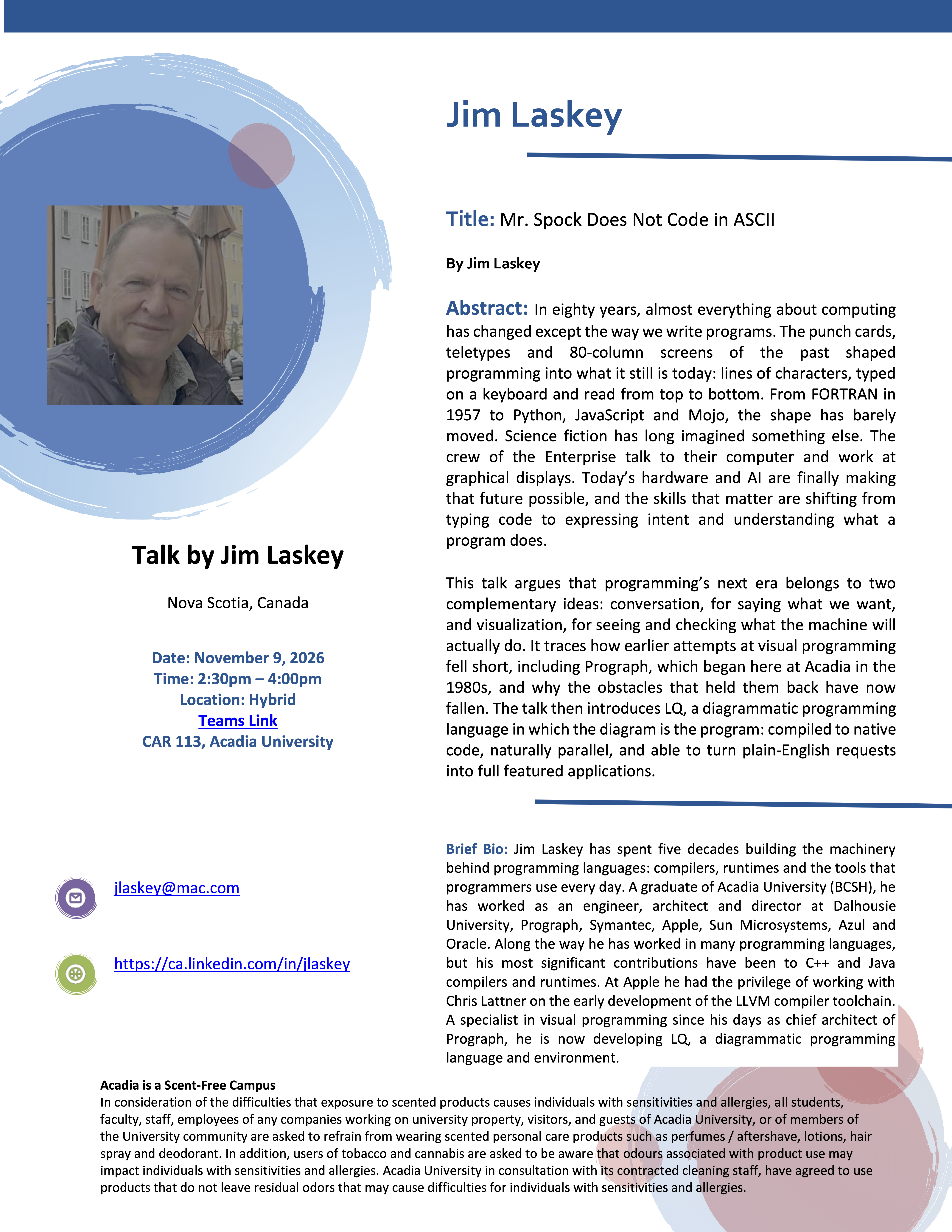
Speaker: Jim Laskey, compiler and programming language engineer (BCSH, Acadia University)
Abstract: For eighty years, almost everything about computing has changed except the way we write programs: lines of text, typed on a keyboard and read top to bottom, a format shaped by punch cards and 80-column screens. This talk argues that programming's next era belongs to conversation, for saying what we want, and visualization, for seeing and checking what the machine will do. Jim will look at why earlier visual programming efforts, including Prograph, which began at Acadia in the 1980s, fell short, why those obstacles have now fallen, and introduce LQ, a diagrammatic language where the diagram is the program: compiled to native code, naturally parallel, and able to turn plain-English requests into full applications.
Short bio: Jim Laskey has spent five decades building compilers, runtimes and tools that programmers use every day. An Acadia graduate, he has worked as an engineer, architect and director at Dalhousie University, Prograph, Symantec, Apple, Sun Microsystems, Azul and Oracle, with his most significant contributions in C++ and Java compilers and runtimes. At Apple he worked with Chris Lattner on the early development of the LLVM compiler toolchain. A visual programming specialist since his time as chief architect of Prograph, he is now developing LQ, a diagrammatic programming language and environment.
Acadia is a fragrance-free campus. Please do not use perfume, cologne or other fragrances so everyone can comfortably attend this session.
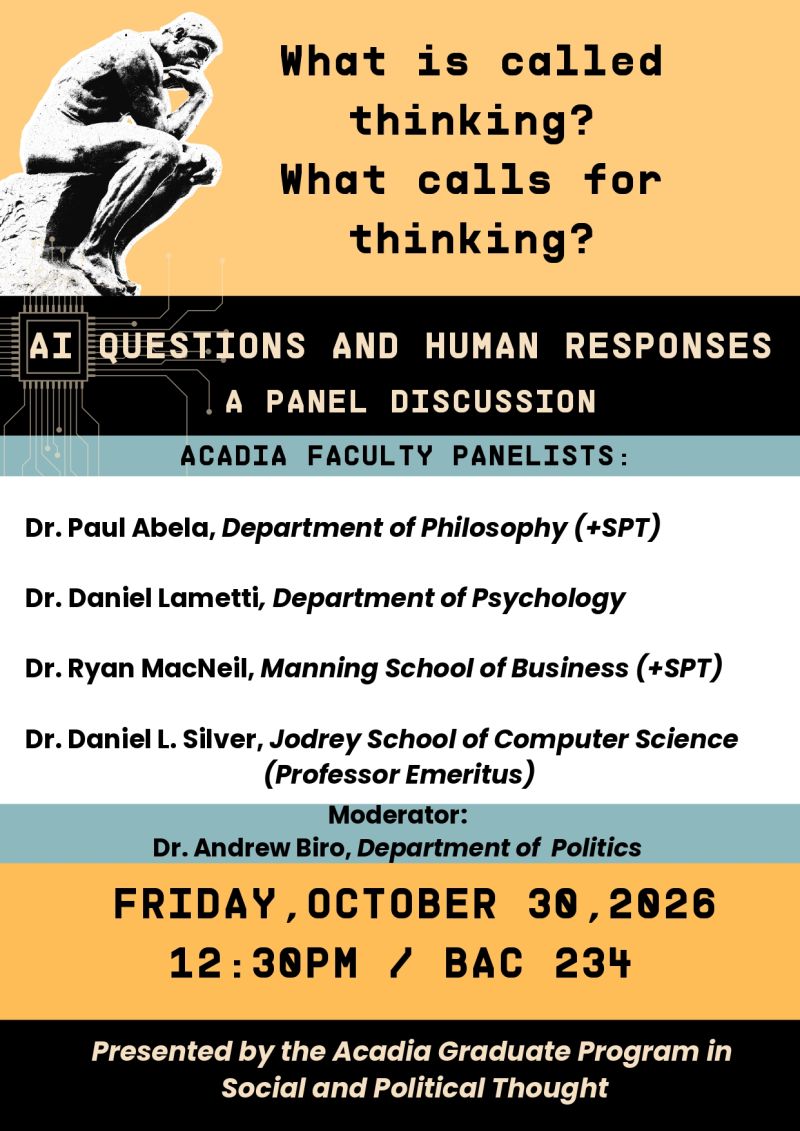
View poster ...AI Questions and Human Responses
Acadia Faculty Panelists:
Moderator: Dr. Andrew Biro, Department of Politics
Presented by the Acadia Graduate Program in Social and Political Thought.
Acadia is a fragrance-free campus. Please do not use perfume, cologne or other fragrances so everyone can comfortably attend this session.
View poster ...
Speaker: Hardik Manek, Head of AI at Site 20/20 (MSc Computer Science, Acadia University, 2021)
Abstract: This talk covers how AI systems are deployed on edge and embedded hardware, where compute, power, and latency constraints shape every design decision. Drawing on production systems he has led, Hardik will present how LiDAR, radar, camera, GNSS, and IMU data are fused into reliable real-time perception, and the practical trade-offs of taking models from prototype to product.
Short bio: Hardik Manek is the Head of AI & ML at Site 20/20, based in Dartmouth, Nova Scotia, where he leads the development of AI-powered systems deployed on edge and embedded hardware. His work spans sensor fusion, real-time perception, and applied AI solutions in areas such as anomaly detection, document intelligence, and process automation, taking systems from prototype to production.
Acadia is a fragrance-free campus. Please do not use perfume, cologne or other fragrances so everyone can comfortably attend this session.
View poster ...